Challenges of Building a Dog Park: An Overview
April 2024
Case Study: Hugh Rogers WAG Dog Park, Whitefish, Montana
I have been involved as a designer and now a Landscape Architect with the Whitefish Animal Group, WAG, Dog Park for over ten years. I was fortunate to come on board when the dream of a select group of dedicated volunteers was finally becoming a reality. This group had tirelessly lobbied the city and other sports associations to develop a dog park within an existing city park utilizing an old soccer field. They persisted through the many hurdles thrown at them, including early opposition from key city staff members.
Things changed when a new Parks Director, Karl Cozad, came to town. Karl’s “we can do it” attitude pushed the project forward. It was invigorating and exciting to have a director who fully supported a volunteer organization in their pursuit of this park. From that point on the Parks and Recreation Department, Parks Board and City Council worked enthusiastically with WAG to create the park.
The first stages were to develop a masterplan for the park and build it in phases as donations became available. I remember working on this first masterplan; the WAG group was afraid that if future ponds, pavilion and asphalt paths were shown they would never be able to raise the dollars. I persisted; a masterplan is a dream for the future, it isn’t set in stone, and it is fluid, but if you fear to dream big, it won’t happen.
We showed the park in phases, with the first phase including a 5′ high fence, bull pen entries and a few asphalt paths. There was much discussion on asphalt paths. Were they really needed?
I thought that the asphalt had several benefits. Not only would they be accessible for wheelchairs and walkers, they would reduce wear and tear on the high traffic areas, stay drier in wet weather and allow snow plowing in winter. The asphalt paths really have been a key positive feature in the park.
WAG fund raised and received donations for the initial phase quickly, and opened its gates in June 2009. Within a year WAG was expanding the trail system to encompass the park and then built a pavilion. An obstacle course grew organically, with found items and donated bits. People donated for a small dog area, benches, trees, a pavilion and a water fountain.
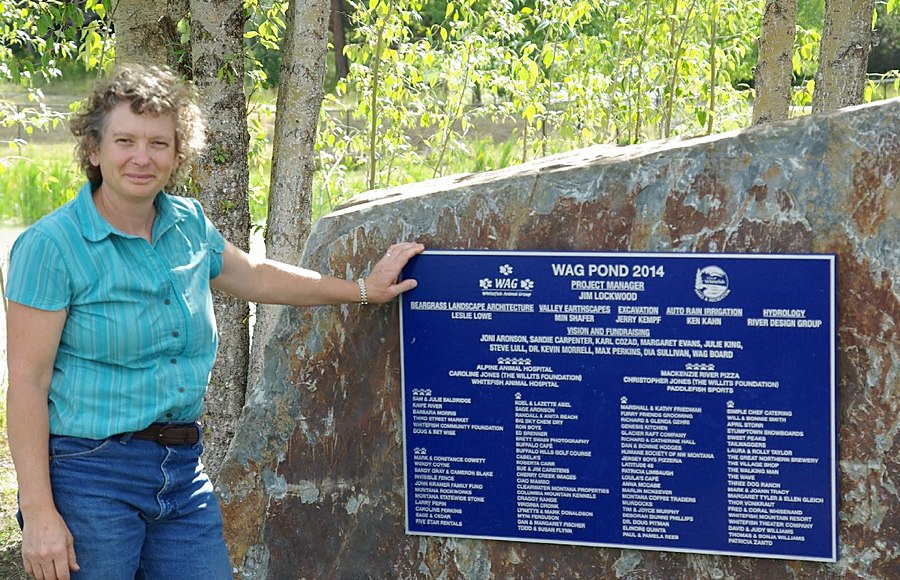
Donors were acknowledged by plaques throughout the park. WAG was very effective in their fundraising campaigns and grant writing. They used the park for fundraising events and had parades and fun runs throughout the community. This park truly was a partnership between WAG and the City of Whitefish.
The last major project was to turn an inaccessible storm water retention pond into a dog pond. WAG again raised significant dollars, and local vendors donated time and materials to make it happen. During the summer of 2014, a good portion of the park was closed as we began construction. We doubled the pond size, added two beaches and stones for sitting, jumping and climbing.
The pond now has an aeration system, and an artesian well that controls water flow, and the park irrigation is now pulled from the pond. This allows WAG to continually circulate fresh water. It is deep enough to allow for year-round fish and WAG will use other natural systems for controlling water cleanliness.
Cattails surrounded the old storm water catchment pond, and these were retained around the majority of the shoreline. Native vegetation was seeded along disturbed banks. Prickly shrubs were planted strategically as barriers to reduce the tendency of dogs to run around the pond. The city provided an additional ½ acre of land to the park to increase the overall size of the park to 5.6 acres.
The City of Whitefish has determined that 30,000+ visitors a year visit the Hugh Rogers WAG Dog Park in Whitefish, Montana. It has visitors from all over North America and the park draws tourists and travelers looking for great dog friendly areas to visit.
I take personal delight and pride in the fact our dog park has caught national attention; being named one of the Ten Best Dog Parks In The USA and featured in articles on how to design a successful dog park.
This park has been a boon to the community and a testimony to the strength of a great volunteer group and city partnership for achieving this dream. Check back here on my website and the WAG website to learn more about the park.
Got a question, a thought, or just want to talk about what’s growing on your property? Reach out — I love these conversations.